Suburban furnace thermostat swap

Usually when we camp, we just use our furnace to warm up in the morning, then shut it off after getting out of bed. When we were up in the mountains of Nevada, and it was really chilly, we let the furnace run for quite some time, and I was surprised at how often the furnace would cycle on and off.

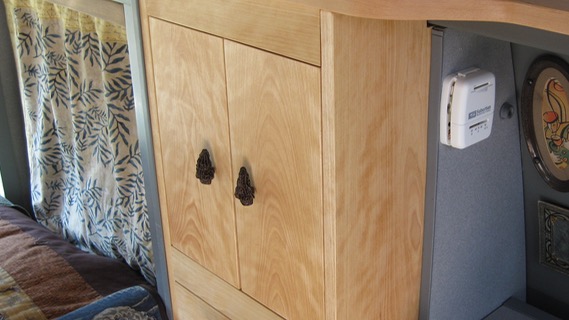
After reading a few posts on the ev_update list about “short cycling” thermostats, I replaced our original Honeywell thermostat with a new Suburban thermostat (White Rodgers thermostat, I think). Here is our original thermostat:

You need to cut the connectors off the wires to the existing thermostat in order to remove the existing thermostat and mount the new one – make sure your house battery is disconnected!

Slide the wires through the backing plate of the new thermostat, crimp on some new connectors, screw them down, reconnect your house battery and try it out!

I ended up with the top screw hole from the old thermostat showing – you can barely see it. The off/on temperature control is on the top, not the bottom, but I think I can live with that – I like the look of the old thermostat better, but I think I can live with that, too.

BIG DIFFERENCE! Now the furnace does not cycle nearly as often. Easy swap out, $30 part (GoWesty and others have them) – make sure it has an “OFF” setting.

Pop top insulation

Reading a post on the ev_update list, I heard about a company making insulation for the inside of the pop top. This was an idea that we had, ever since a very cold night in the mountains of Nevada. So I contacted Fancher’s Upholstery and after a few emails, decided to order one. After a couple weeks (they make 2 at a time), the insulation arrived, nicely packaged:

You can see the instruction sheet, roll of velcro, stuff sack, and the Fancher business card (I love little touches like that…)

The whole things fits into an included stuff sack, about the size of a pillow case:

The insulation is a nice cream color on the inside face, and a very weatherproof looking gray on the outside. Fancher’s claims an insulation value of R-8 for the fabric, which consists of five layers – I can tell you it is very high quality fabric. The workmanship is impeccable – take a look:


Installation is very easy – the insulation fastens with velcro, and strips of 2 inch wide velcro are provided, as well as instructions on where and how the velcro should be installed. The pieces they provided are not labeled, but I used a little common sense and figured it out:


The velcro mounts between the pop top canvas and the pop top, under the aluminum strip that holds the pop top in place. I marked out the screw locations (just for alignment purposes), then used a pencil to mark a horizontal line in the middle of the velcro – to make sure I would have at least 1 inch of velcro sticking out. I removed just the screws needed for each piece, working with one piece at a time, slipping the velcro between the canvas and the pop top, “fuzzy side” UP, then replaced the screws, piercing the velcro, and tightening the aluminum strip.

TIP – lower your pop top slightly when removing the screws that hold the pop top in place – that way, the fabric will not be under any tension.


After I installed the velcro, I made sure to clean up the roof below the pop top, to collect any metal shavings and dirt (didn’t want to get the new insulation dirty!). To install the insulation, just fold down the velcro mounted on the pop top (it acts like a tab), and slide the insulation right up to it – VOILA!:

The front panel rolls up to allow for access to the storage above the cab.


If you have a top bunk, the insulation can slide right under the mattress for a snug fit – we don’t have an upper bunk, and our pop top canvas is slightly shorter than stock (due to an unfortunate carport incident that required some major repair to our canvas), so the side panels have some extra room. If you want to get really fancy, you can line up all the horizontal stitches – the workmanship is that good (see below!):

On the Fancher’s website, the insulation is shown going BEHIND the pop top hinges – since the insulation is “roomy”, I chose to go “IN FRONT” of the hinges, attaching 11 3/4 inches of 1 inch wide black industrial velcro to the hinge face, like so:

If you camp in the cold, you really should get this for your EVC – come one, you KNOW you deserve it! Give Fancher’s Upholstery a call or email, you will really like their product!

Upcoming projects

It has been a little quiet on the EVC modification front for a while – other things have been taking up my time.

Here is a list of upcoming projects (in no real order):

Propane regulator and supply hose replacement
Propane tank removal and repaint
Outside temperature gauge
Norcold fuse holder modification
Improved battery monitoring (current, watts, etc)
Insulated poptop “liner” installation
LED reading lights above the bed

Stay tuned….

Converter upgrade

I recently replaced my “house” battery, and since those darn things are not cheap (the brand of the battery is named “Trojan”, to give you an idea) – I wanted to take good care of it.

In the Eurovan Camper, there is a “converter” – it’s job is to supply 12 volts to the furnace, power to 12 volt outlets, and to charge the house battery when connected to AC (“shore power”). The stock converter is a Magnatek – a HUGE unit that provides very “dirty” (unregulated) 12 volts, as well as poor performance as a battery charger. I felt I could install something “better”, so when connected to shore power my new battery was getting some “good loving” (see above Trojan reference) and any 12 volt devices were getting some “clean” power (again, see above).

I chose an Progressive Dynamics Intelli-Power model PD 9245C from Best Converter. It has a remote “pendant” for controlling the state of the charger (boost, normal, storage), which is easy to mount on the electrical panel.

You will need some 1/8 inch thick by 3/4 or 1 inch wide aluminum (non-anodized) bar stock, hacksaw, drill, patience, an afternoon, and your favorite libation (for consumption when you are done).

Disconnect your house battery and shore power and shutoff your propane before starting!

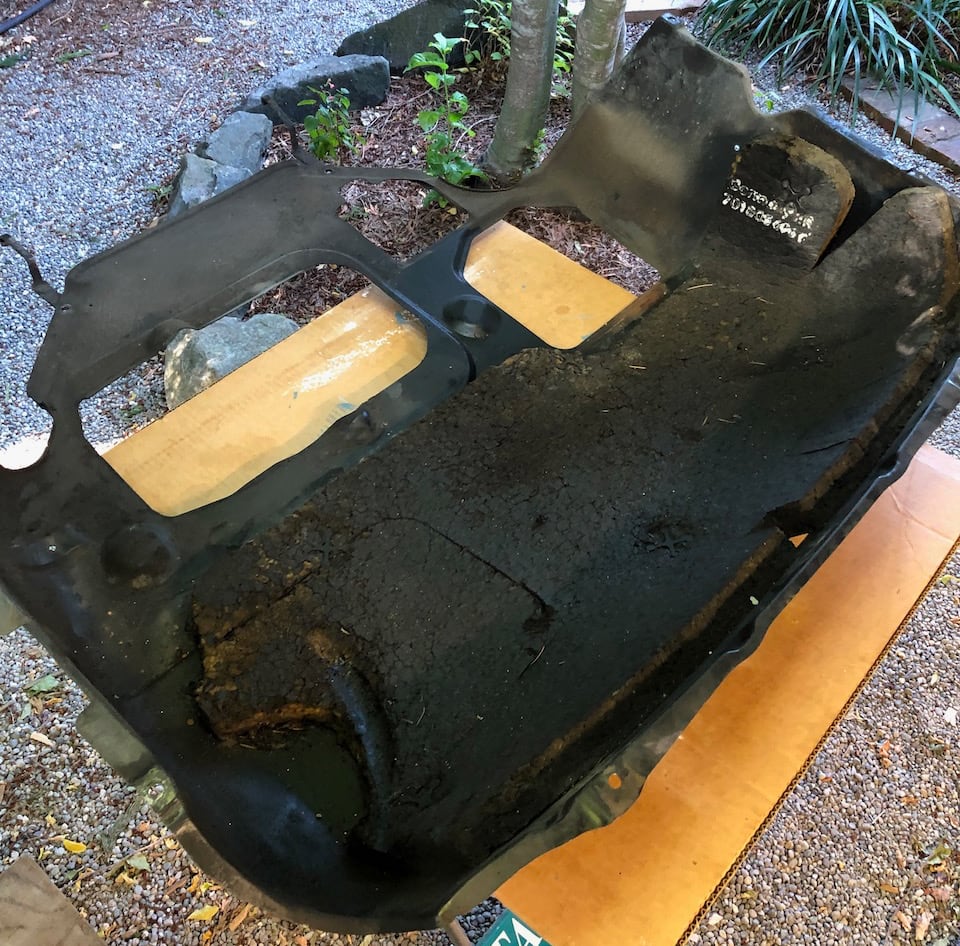
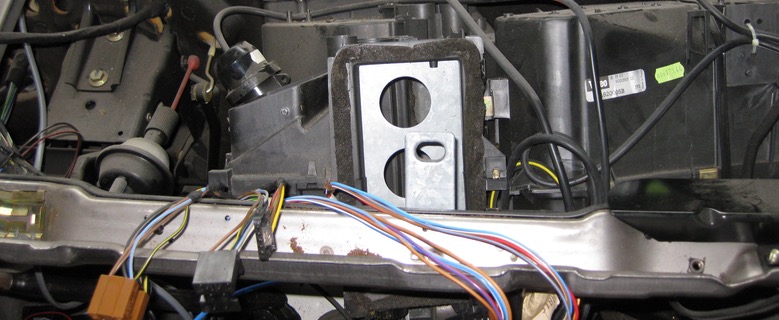
To install, you need to remove the back seat, the two plastic shrouds over the furnace ductwork and the water fill area, and your furnace (really easy – disconnect propane, unplug electrical, open front cover, remove two screws, slide out) – so you end up with this (sorry, did not take photos of the stuff coming out – this shows the new converter):

You could do this without removing all this, but it is really nice to have the room, and while you are in there you can replace all your driver side taillights! (use ORIGINAL Honda ones – very good quality! – single filament part # 34903-SF1-A01, dual filament part # 34906-SL0-A01)

Once you have the furnace out, remove the front bracket that the furnace was screwed to – notice that the mounting holes for the furnace are in the front of this bracket – you will need to remember this when you put it back!

Now you have LOTS of room – notice how the Magnatek looks like a piece of WWII surplus gear? If yours is still working, you can use it to create a test power source for your Norcold bench test rig (upcoming project…).

IMPORTANT!
All the wiring in the “house” part of your van follows the same color codes as your home – black is HOT, green is ground, etc.

Unscrew the front cover to the Magnatek and undo the 3 wire nuts that connect the Magnatek to your house wiring (umm… guys, wire nuts are NOT for use in vehicles…. jeez….). If you read the panel of the Magnatek, you will see that there are 2 hot and one neutral output – one hot is “filtered” (yeah, in your dreams…) and one is not. The “filtered” lead is the smaller one, and it supplies current to the 12 volt outlet near the fridge.

You will notice that the Intelli-Power has only 2 terminals – you DO NOT connect the “filtered” wire to the Intelli-Power – here is why:

SAFETY NOTE
Fuses protect WIRES, not what the wires connect to – a device may (or may not) have internal fuses or other means to protect itself. If you connect a small wire to a large fuse, the wire could heat up from excess current, possibly causing a fire – long before the fuse would fail.

So what you need to do is remove the small “filtered” wire, and extend the aluminum buss that joins all the other 12 volt fuses – like so:

BEFORE:

AFTER:

Now you have one hot and one neutral wire – perfect for the Intelli-Power.

Next change – the Magnatek has a right angle plug – the Intelli-Power does not. My solution was to change the mounting position of the house outlet this connects to by drilling two new holes in the mounting back mounting plate (unscrew this to make the job easier) and putting the outlet on the INSIDE of the mounting bracket:

BEFORE:

AFTER:

Screw the Intelli-Power to the floor – also, screw in the old screws from the Magnatek to plug the unused holes – TIP: use some silicone around the screws to seal them up and minimize corrosion.

Also, check the tightness of the bolt that holds all the hot wires to the battery (remember, black is HOT when working in the “house” part of your van):

As a side note, on my model of Eurovan, the line to the rear sprayer runs under the converter. We have never used our rear sprayer in almost 10 years, and I don’t like mixing electricity and water, so I removed the rear sprayer “T” connection to make it more tidy back there.

When you connect the wires to the Intelli-Power – do not over tighten the terminals. You also want to wiggle the stranded wires after you think it is tight enough, and retighten. There is an inch pound torque value listed on the Intelli-Power – you will want to follow that.

Make sure to test this BEFORE you put all the bits and pieces back together – maybe even run it for a few hours while you enjoy your tasty beverage, and put the pieces back on the next day! Check the voltage at one of the 12 volt outlets – it should be 13.6 while plugged into AC (may be up to 14.2 if your battery needs a “boost”), 13.2 for a “float” charge, and 12.8 or thereabouts when unplugged, depending on the condition of your house battery. The remote pendant indicates the “mode” the pendant is in.

Here is some more info on the remote pendant: Progressive Dynamics.

Here is what it looks like with the furnace installed:

Here is where I mounted the remote pendant (it is the thing with the silly wizard graphic):

Engel Fridge Temperature Gauge

After having our Norcold fridge fail on us (fuse blew on the DC heater) during a long slog up the coast on a rainy Thanksgiving (fortunately all the leftovers were in another ice chest!), I decided that I needed a way to monitor the fridge temperature remotely. I found that Engel (makers of electric coolers) have a remote temperature accessory – Amazon link that looked to be a perfect solution.

For my recent month long trip to Peru*, I needed to keep certain medical supplies between freezing and 46 degrees – so monitoring the temperature was critical.

I mounted the unit on the dashboard using INDUSTRIAL Velcro, as well as creating a mounting spot next to the fridge:

There is a remote sending unit that I mounted on the inside “roof” of the fridge (no photo). The Amazon link shows the displays on the device.

The unit uses AAA batteries, and they will last you AT LEAST one month of 24/7 operation. The unit could use a backlight for nighttime, but I don’t mind the tradeoff for long battery life. It also displays the time and ambient temperature.

The remote connection was “lost” only 3 times during my trip – twice I feel it was due to the iPhone located nearby starting up in the AM. Repairing the connection requires removing the batteries from both units, then installing the batteries FIRST in the receiver, THEN in the remote. This also requires stepping through the menu to set the time and choosing Centigrade or Fahrenheit, but that process is simple.

This should be standard equipment with all fridges.

*(Indiana)

House battery disconnect

I wanted to have an easy way to disconnect my house battery for servicing 12 volt appliances, etc., so I added a battery disconnect switch – accessible via my rear access hatch – Adding a rear hatch.

I purchased a switch, and a short battery cable:

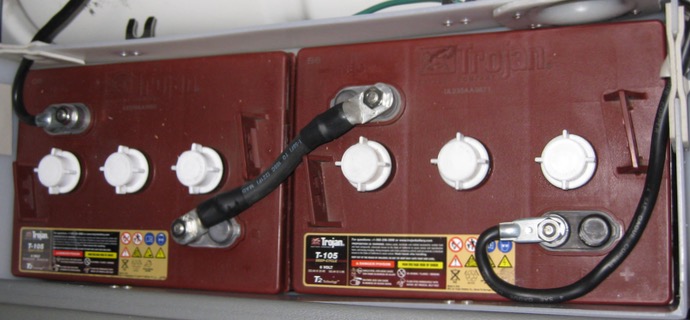
Here are some shots of inside the battery box – it is tight, but it all fits:

Drilled a hole in the battery box, rerouted the positive cable (sealing the new hole I drilled for it), connected the short cable from the battery to the switch, and that was it!